



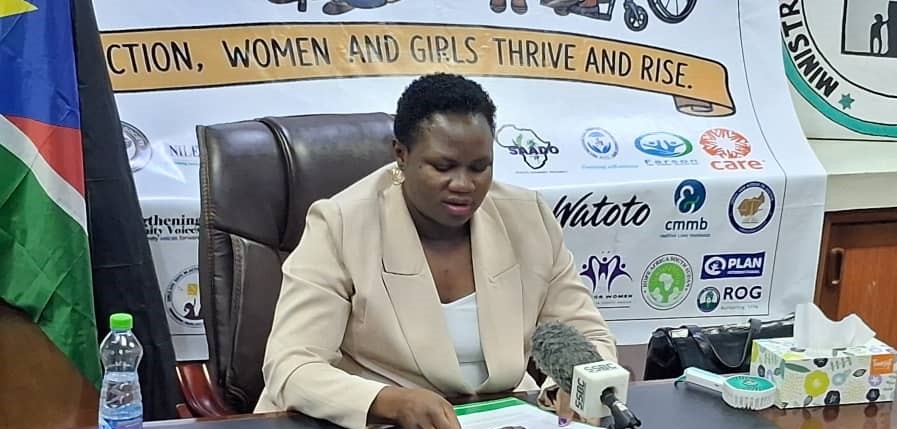
South Sudan’s Minister of Gender, Child and Social Welfare has called on families, communities and institutions to step up efforts to protect children and improve their access to basic services, ahead of the International Day of the African Child.
Speaking at a press conference on Monday, Nunu Rhoda Rudolf said this year’s commemoration is being held under the theme “Ensuring Equal Access to Water, Sanitation and Hygiene (WASH) for Every Child in South Sudan.”
“Today, South Sudan joins the rest of Africa in commemorating the Day of the African Child under the theme Ensuring Equal Access to Water, Sanitation and Hygiene,” she said.
She said access to clean water, sanitation and hygiene is a fundamental right that underpins children’s health, dignity, education and protection.
“For every child in South Sudan, this theme reminds us that access to safe water, sanitation and hygiene is a fundamental right essential to the health, dignity, education and protection of every child,” she said.
Rudolf urged parents and caregivers to take greater responsibility in raising and protecting children, warning against exposing them to street life and related risks.
“As we mark this important day, I call upon parents and caregivers to provide responsible parenting and ensure that children are protected, guided and nurtured within their families,” she said. “Children should not be left to loiter on the streets, where they are exposed to abuse, exploitation, violence, trafficking and other harmful practices.”
She acknowledged the role of humanitarian and development partners in supporting vulnerable children, while stressing that family and community-based care remains the preferred option.
“The ministry recognizes the efforts of humanitarian and development partners in supporting vulnerable children. While orphanages may provide temporary care when properly regulated, family and community-based care remain the best option for ensuring the well-being and development of children,” she said.
Rudolf also reiterated the government’s position against child labour, child trafficking and the recruitment of children by armed groups, describing them as serious violations of children’s rights.
“The government of South Sudan reiterates that child labour, child trafficking and the recruitment and use of children by armed groups are serious violations of children’s rights and are prohibited under national and international law,” she said.
She said every child has the right to protection, education and a safe environment in which to grow and develop.
“Every child has the right to protection, education and a safe environment in which to grow and thrive,” she said.
The minister called on government institutions, development partners, communities and families to work together to improve access to clean water, sanitation and hygiene services for children across the country.
“I call upon government institutions, partners, communities and families to work together to ensure that every child has access to clean water, safe sanitation, proper hygiene and a protective family environment,” she said. “Together, let us build a South Sudan where every child is healthy, safe and protected.”
The Day of the African Child is marked annually on June 16 to promote children’s rights and raise awareness of challenges facing children across the continent.

 and then