



Sudanese political and civil forces opposed to the war have rejected an initiative by military leader Abdel Fattah al-Burhan for a “Sudanese-Sudanese dialogue”, saying they would neither participate in the process nor recognize its outcomes.
The groups instead proposed an alternative peace roadmap built around three parallel tracks: humanitarian assistance, a permanent ceasefire and an exclusively civilian political process.
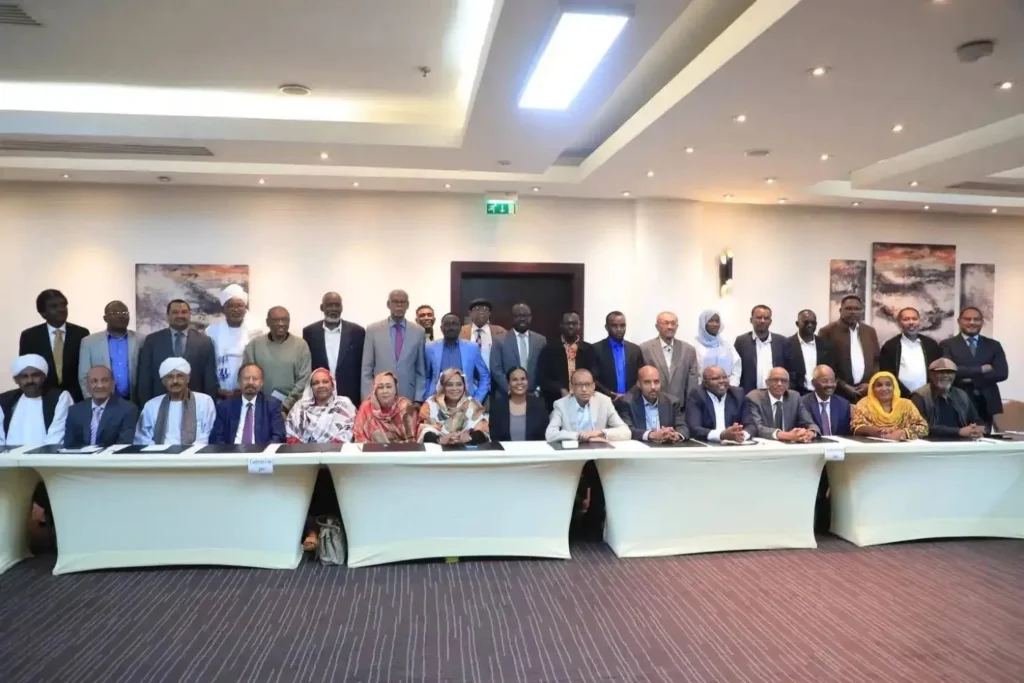
The position was announced after consultative meetings held in Ethiopia’s capital Addis Ababa on Aug. 22-23. The talks brought together forces associated with the Sudanese Declaration of Principles, the Popular Congress Party, the National Umma Party, civil society groups, women’s and youth networks, academics and independent public figures not aligned with either side of the war.
Participants included Sumoud Coalition head Abdalla Hamdok, Sudan Liberation Movement leader Abdel Wahid al-Nur, Umma Party leader Mubarak al-Fadel and Baath Party figure Wajedi Sleh, among others.
The meeting focused on the worsening humanitarian crisis, efforts to halt the fighting and the restoration of Sudan’s democratic transition, according to a joint position paper issued at its conclusion.
The groups said Burhan’s initiative was unilateral and being organized in areas under the control of one side of the conflict and its security apparatus. They said the process risked legitimizing the status quo and deepening Sudan’s de facto division into rival zones of control.
They also accused the initiative of providing political cover for continued military rule following the Oct. 25, 2021 coup and creating a pathway for the return of figures and groups linked to former President Omar al-Bashir’s National Congress Party and the Islamic Movement.
The groups questioned the legitimacy of a preparatory committee appointed unilaterally and said political talks could not be separated from an immediate ceasefire, unrestricted humanitarian access and efforts to address alleged atrocities.
Under their alternative proposal, the peace process would be conducted through equal negotiations under an agreed independent international framework.
The humanitarian track would focus on urgent relief, while the second would seek a permanent ceasefire. The third would be a civilian-led political process addressing the root causes of the conflict, including governance, equal citizenship, the creation of a unified and professional national army, dismantling remnants of the former regime and transitional justice.
The proposal envisages participation by three broad political currents: anti-war forces not aligned with either belligerent, forces aligned with the Sudanese Armed Forces and forces aligned with the Rapid Support Forces.
The two military factions, however, would be restricted to discussions on the ceasefire and humanitarian issues, while the National Congress Party and affiliated groups would be excluded from the political process, the statement said.
On international mediation, the groups endorsed the Quartet Roadmap issued on Sept. 12, 2025, saying it provided the clearest framework for ending the war and establishing a civilian-led political future.
They also said they were prepared to engage with the Quintet Mechanism, provided Sudanese parties retained ownership of decisions and international mediation efforts were consolidated into a single process.
The groups said a unified mediation effort was necessary to prevent the warring parties from exploiting divisions among international mediators.
Burhan said on Aug. 14 that he supported legal, political and security guarantees to facilitate an internal dialogue. The Addis Ababa meeting rejected the proposal, saying it sought to impose a fait accompli rather than create the conditions for a sustainable peace.

 and then