



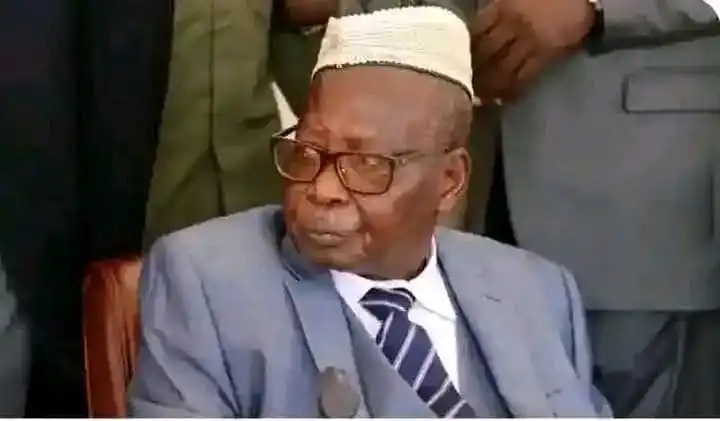
Detained former First Vice President Dr. Riek Machar on Wednesday praised the late Gen. Joseph Lagu as a selfless leader who prioritized peace and self-determination over personal ambition, saying he was not greedy for power.
In a condolence message following Lagu’s death during the 125th session, Machar said the veteran Southern Sudanese leader deserved recognition for his contribution to the liberation struggle and his commitment to the welfare of the people.
“Well, I am in a cell, so I do not know how best to convey my condolences on the passing of a great leader, Hon. Joseph Lagu,” he said. “He was a great leader who brought peace and self-determination to Southern Sudan. He was not a selfish leader, nor greedy for power—that is why he left leadership to another person who was not originally part of the movement and liberation.”
“He is a true, iconic leader known for his dedication to the welfare of the people of South Sudan. He will always be remembered. May his soul rest well in peace,” he added/
Lagu was a prominent figure in Southern Sudan’s liberation history, particularly through his leadership in the Anyanya movement and his role in the 1972 Addis Ababa Agreement, which ended the first Sudanese civil war and established regional autonomy for Southern Sudan.
Gen. Lagu was a central figure in southern Sudan’s struggle for autonomy. He helped negotiate the 1972 Addis Ababa Agreement, which ended the first north-south civil war and granted the region self-government.
Born on November 21, 1931, in Momokwe, in the Madi area of what is now South Sudan’s Eastern Equatoria state, Lagu trained as a military officer before defecting from the Sudanese army in 1963 to join the southern rebellion.
In 1968, he became leader of the Southern Sudan Liberation Movement and commander-in-chief of its armed wing, Anyanya. Under his leadership, the movement negotiated the Addis Ababa Agreement with the government of President Gaafar Nimeiry in 1972, ending a conflict that had begun in 1955.
Lagu returned to the Sudanese army after the agreement and rose to the rank of lieutenant-general. He served as president of the High Executive Council of the autonomous Southern Region from 1978 to 1979 and as Sudan’s second vice-president from 1982 to 1985.
The agreement granted southern Sudan a decade of regional self-government. Nimeiry abrogated it in 1983, a move that contributed to renewed conflict in the south.
Lagu’s forces included young officers who later became prominent figures in South Sudan’s history, including Salva Kiir and the late John Garang, who served under his command during the Anyanya rebellion.
After Nimeiry was overthrown in 1985, Lagu settled in Britain before returning to public service as Sudan’s roving ambassador from 1988 to 1990 and again from 1992 to 1998. He also served as Sudan’s permanent representative to the United Nations from 1990 to 1992.
After South Sudan gained independence in 2011, Lagu served as a special adviser to Kiir. He had also held an advisory role during the autonomous southern Sudan administration before independence. He later retired from active public service.
In November 2022, his family launched the Joseph Lagu Foundation, which focuses on education, leadership development, community empowerment, and humanitarian assistance in South Sudan.
Lagu completed his memoir, Sudan Odyssey: Through a State from Ruin to Hope, in 2006. His career spanned the southern rebellion, peace negotiations, senior government positions and diplomatic service, as well as the early years of South Sudan’s independence.
Gen. Lagu is survived by several children, including Josephine Lagu, who previously served as a vice-president in the Transitional Government of National Unity.

 and then