



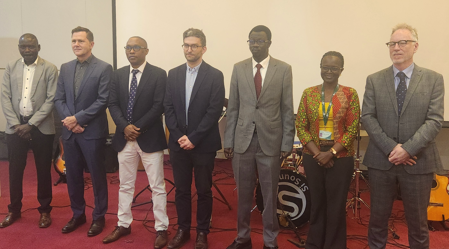
The Ministry of Agriculture and Food Security has called on international development agencies to ensure that at least 70 percent of employees working on donor-funded projects are South Sudanese, citing limited employment opportunities for qualified local graduates.
Morris Aduol Dut, the ministry’s undersecretary, said international organisations, particularly the Food and Agriculture Organization (FAO) and the United Nations Office for Project Services (UNOPS), should prioritise employing South Sudanese in their programmes, with foreign nationals accounting for the remaining 30 percent.
Speaking during the annual SSHARP Resilience Learning Fair organised by FAO, the World Food Programme (WFP) and the THRIVE Consortium in Juba on Thursday, Aduol said many young South Sudanese graduates had approached his office seeking employment but were struggling to secure opportunities in development projects.
“I have been receiving a lot of young South Sudanese in my office. They are calling; they need work, employment,” he said. “I am calling upon FAO, UNOPS, especially those working with the Ministry of Agriculture and Food Security, and all our programmes; at least, there must be 70 percent of South Sudanese as employees in any project. Thirty percent must be foreigners.”
“We have graduate South Sudanese who are capable of doing this work here, but they’re not given the opportunity. It’s their right for them to be employed,” Aduol added.
Aduol criticized delays in the implementation of development projects, saying communities were waiting for services despite funding being made available.
He cited projects he had visited in Renk and Malut in Upper Nile State, questioning the size of some completed structures in relation to the money allocated.
Duncan Overfield, Deputy Development Director at the British Embassy in Juba, whose government supports the South Sudan Humanitarian and Resilience Programme, said UK-funded interventions were working with local organisations to strengthen community resilience.
He said the UK was supporting the THRIVE Consortium, WFP and FAO to help vulnerable households diversify their livelihoods, establish businesses and adapt to the effects of climate change.
“We’re proud that UK funding through the Foreign, Commonwealth and Development Office (FCDO) is working in partnership with local actors, acknowledging the central role local NGOs play in strengthening resilience,” Overfield said.
He added that resilience programmes should go beyond helping communities survive immediate crises to building foundations for sustainable development through livelihood diversification, improved market access and skills development.
Overfield said the UK-supported programme had recorded progress in savings and lending activities, with communities using loans to establish and expand businesses.
He also highlighted the involvement of private-sector actors in the fisheries and livestock sectors, saying such partnerships demonstrated the potential for private-sector development even in fragile and conflict-affected environments.
Meanwhile, Phyllis Sepkorir, Country Director of GOAL South Sudan and a representative of the THRIVE Consortium, said sustainable resilience-building required strengthening local institutions and communities rather than treating them merely as recipients of assistance.
“Localization is not just a principle that we discuss in meetings. It is essential for achieving sustainable and lasting impact,” Sepkorir said.
Thomas Deville, WFP’s Deputy Head of Programme in South Sudan, also called for stronger strategic partnerships that bring together development organisations to pool resources and support vulnerable communities.
He said WFP wanted to move away from purely transactional partnerships towards longer-term cooperation aimed at strengthening community resilience and self-reliance.
Nicholas Kerandi, Project Manager for the Green and Resilient Agriculture and Climate Economy at FAO South Sudan, called for greater attention to communities in Greater Upper Nile, saying the region had some of the country’s highest humanitarian needs but received comparatively less funding.
He said the perception that parts of the region were difficult to access had contributed to limited investment, urging development partners to shift attention from emergency assistance towards longer-term development and resilience programmes.
The learning fair brought together government officials, development partners, UN agencies, civil society organisations and community representatives to share experiences and lessons on strengthening household and community resilience.
The United Kingdom, through its FCDO, supports the South Sudan Humanitarian and Resilience Programme, under which the THRIVE Consortium works with communities and partners to strengthen resilience.

 and then